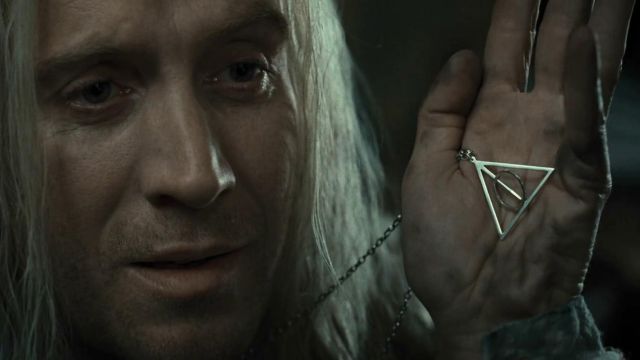
The Deathly Hallows symbol (triangle, circle, and line) is officially tied to the three Hallows and the Peverell family—but a strong in-world theory says it also “fits” Hogwarts so well because it secretly mirrors the Hogwarts Founders and what they built: a school designed to master the biggest human fear, death, by shaping how witches and wizards live.
Recommended for You:- The Dark Connection Between Dementors and the Veil in the Ministry
- Why the Forbidden Forest Is More Important Than You Realize
- The Secret History of Ollivander’s Wand Shop Uncovered
- How the Goblins of Gringotts Hold the Key to Wizarding Power
What the symbol really means
In canon, the Deathly Hallows sign is a single mark made from three parts: the Elder Wand (a vertical line), the Resurrection Stone (a circle), and the Cloak of Invisibility (a triangle around them).
The symbol becomes widely known again in Harry’s era partly because it’s associated with people who hunted the Hallows—like Xenophilius Lovegood—and because it was used as a mark by Gellert Grindelwald earlier in the 20th century.
The founders connection (the big idea)
Hogwarts was founded in the medieval era by four witches and wizards—Godric Gryffindor, Helga Hufflepuff, Rowena Ravenclaw, and Salazar Slytherin—who built the castle and created the Houses to pass on their values.
The theory claims the Hallows symbol echoes Hogwarts because Hogwarts itself is a “four-part system” hiding inside a “three-part myth”: three Hallows are about power over death, while Hogwarts (built by four founders) teaches students to face death through courage, loyalty, wisdom, and ambition.
How the Hallows map to founders
This isn’t stated in the books as a literal historical fact, but it’s a popular theory because the shapes are simple and symbolic, and the founders’ most famous legacies are also objects, secrets, and values that outlive them.
- The Elder Wand (line) matches Slytherin/Gryffindor themes of power and dominance—especially because both Houses produce many duelists and leaders, and the wand’s history is about conquest.
- The Resurrection Stone (circle) aligns with Ravenclaw’s “mind over loss” idea: the stone represents obsession with answers you can’t truly have (bringing someone back), which is a dark version of seeking forbidden knowledge.
- The Cloak (triangle) can mirror Hufflepuff’s protection and community: the cloak is the only Hallow meant to be used quietly and safely, and it’s passed down through family rather than won through violence.
And then comes the twist: the symbol has three parts, but Hogwarts has four founders.
Theory writers often answer this by saying the “missing fourth” is Hogwarts itself—the container around all of them—just like the triangle contains the circle and line.
The Peverells, Hogwarts, and “old magic”
The Hallows are connected to a medieval family, the Peverells, who are widely believed to be the three brothers from “The Tale of the Three Brothers,” and the symbol even appears on Ignotus Peverell’s grave.
Because Hogwarts was also founded in roughly the same broad historical period (over a thousand years ago, exact date uncertain), it’s believable in-universe that founders-era wizard culture and Peverell-era legend could overlap in symbolism and secret societies.
A key extra link: Ignotus Peverell’s Cloak becomes a Potter family heirloom through inheritance, and Harry later realizes he is descended from the third brother.
That matters because Hogwarts is where Harry’s identity, lineage, and destiny are fully revealed—so the Hallows mark can feel like it “belongs” to Hogwarts even if it didn’t start there.
Why Hogwarts would “hide” a Hallow-shaped message
In the story, Dumbledore treats the Hallows as real objects but also as a moral lesson: chasing them for control ends badly, while accepting death is the wiser path.
That lesson is basically what Hogwarts tries to do across seven books: it doesn’t just teach spells; it forces students to grow up around danger, grief, and sacrifice until they understand what kind of life is worth living.
So the theory is not “the founders invented the Deathly Hallows symbol,” but “the symbol’s meaning matches the founders’ mission so closely that it feels like a founders-era emblem.”
In other words, Hogwarts is the place where the Hallows’ three temptations—unbeatable power, undoing death, and hiding from death—get tested against the founders’ four virtues.
A simple version of the theory (easy to picture)
Imagine Hogwarts as a training ground built by four people, and the Hallows as a legend built around three objects.
Now imagine the Deathly Hallows symbol as a “map” of what Hogwarts creates: students who can seek power (wand), face grief (stone), and protect each other (cloak), but must learn balance or they become dangerous.