Ollivander’s Wand Shop sits quietly in Diagon Alley, squeezed between busy wizarding stores and loud crowds of shoppers. To most witches and wizards, it is simply “the wand place”—a dusty, old shop where you go once in your life, get your wand, and then move on. But if you look closely at the details we see in the Harry Potter books and films, Ollivander’s is not just a store.
It feels like a museum. A vault. Almost a shrine.
The shop’s darkness, the endless wand boxes stacked like sleeping memories, and Garrick Ollivander’s strange way of speaking all suggest the same thing: this place carries secrets. And those secrets may be older than Diagon Alley itself. In this theory article, we’ll uncover a hidden history of Ollivander’s Wand Shop—why it seems built to protect knowledge, how it may have shaped major events, and what Garrick Ollivander might not be telling anyone.
Recommended for You:- Why the Deathly Hallows Symbol Is Linked to Hogwarts Founders
- The Dark Connection Between Dementors and the Veil in the Ministry
- How the Goblins of Gringotts Hold the Key to Wizarding Power
- Why Harry’s Broomsticks Were Always Destined to Save Him
Why Ollivander’s feels older than everything else
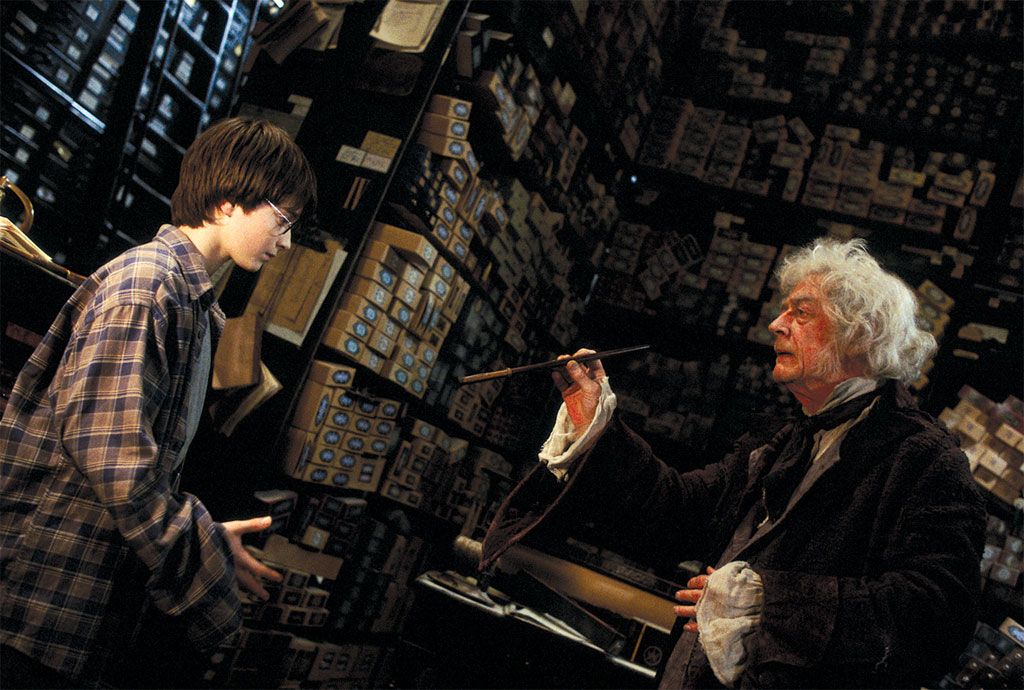
When Harry first steps into Ollivander’s in Philosopher’s Stone, he walks into silence. The shop is narrow and dim, with towers of boxes and a sense that time has stopped. This is an odd way to run a business in a busy shopping street. Good shops try to look inviting. They show products. They use bright windows.
Ollivander’s does the opposite.
A simple explanation is: it is old-fashioned. But a stronger theory is that the shop is designed to hide things in plain sight. Its darkness and clutter are not accidents—they are a kind of protection. Wandmaking knowledge is dangerous in the wrong hands. If someone could copy wand designs, steal rare cores, or learn how wand allegiance works, they could gain power very fast.
So what if Ollivander’s has always been part shop and part secret archive?
The wand boxes are not only packaging. They are records. Each box holds a wand, and its label holds a history: wood type, core, length, flexibility, and sometimes who bought it. That means Ollivander’s is basically a living database of British magical citizens and the tools that amplify their magic.
In a world where information is power, a record like that is priceless.
Ollivander’s as the “memory bank” of British magic
Garrick Ollivander famously tells Harry: “I remember every wand I’ve ever sold.” Most people treat this line as a fun character trait—an eccentric genius who loves his craft. But that statement is almost unbelievable.
He has sold wands for decades. Maybe centuries, if his family line and training go back far enough. So how does he remember every wand? A normal human memory should fail.
This leads to a key theory: Ollivander’s shop itself helps him remember.
In the wizarding world, places can hold magic. We see enchanted tents, bewitched houses, portraits that remember people, and objects that store thoughts. The shop could be charmed like a Pensieve in architectural form, keeping the “imprint” of every wand that passes through it. The stacked boxes may also act like anchors, each one holding a small trace of the wand inside.
If that’s true, then Ollivander is not just talented—he is connected to a magical system. The shop supports him, and he supports the shop. Together, they form something like a “memory bank” for wandlore.
This also explains why Ollivander can instantly connect Harry’s wand to Voldemort’s wand. It isn’t only that he is clever. It’s that he has a perfect record, backed by magic, of what he has made and sold.
The shop’s location may be part of the secret
Diagon Alley is the main shopping street for British witches and wizards. That means it is central, guarded, and constantly visited. If you wanted to hide a powerful archive, putting it in the safest public place is a smart move.
This is a classic trick: hide the treasure where everyone can see it, because nobody will suspect it.
Ollivander’s is one of the oldest and most respected shops in the Alley. It is easy to imagine that the Ministry of Magic (or powerful families) would rather have the wandmaker’s knowledge protected in the heart of wizarding London than hidden in a remote place where dark wizards might attack without witnesses.
Also, Diagon Alley has deep magical protections. We see it as a place that Muggles can’t enter easily, and it is tied closely to Gringotts and the Ministry. If Ollivander’s needed quiet protection, Diagon Alley is a natural shield.
So the location is not just good business. It may be part of the shop’s security plan.
A hidden purpose: controlling wand standards in Britain
Here is a more daring theory: Ollivander’s isn’t only selling wands. It is controlling wand culture.
In the Harry Potter world, there are different wandmakers in different countries. But in Britain, Ollivander’s is treated like the wand shop. Students all go there. Teachers trust it. Even the Ministry seems to accept its authority.
That kind of dominance does not happen by accident.
If almost every British witch and wizard uses an Ollivander wand, that gives the Ollivander family massive influence over how magic is practiced. Not direct control—wands choose the wizard—but they do set standards:
- Which woods and cores are “normal”
- Which wand lengths and flexibilities are common
- How wands are repaired or replaced
- How wand allegiance is understood
If a rival wandmaker tried to change the system, they would need to fight not only a business, but a tradition. In that sense, Ollivander’s might function like a guild headquarters: a place that quietly keeps wandmaking stable and trusted.
This could also be why the shop feels so strict and ritual-like. It isn’t trying to be modern. It is trying to be authoritative.
The “wand box towers” could hide more than wands
Let’s talk about the most famous visual detail: the endless stacks of wand boxes.
We assume they all contain wands. But do they?
Ollivander’s shop is described as cramped, with boxes to the ceiling. That is a lot of inventory for a store that sells one wand per person, and only occasionally sells replacements. Yes, wands are personal and the shop likely keeps many options. Still, the scale feels too big.
That opens a possibility: some boxes might be decoys, and some shelves might hide other items—rare cores, forbidden woods, prototypes, or even wands that should never be sold.
We know some wand cores are very rare, like phoenix feather. We also know some wand woods have strong personalities. A wandmaker might create experimental wands to test theory, or keep dangerous ones locked away.
Where would you hide such things?
The safest place is inside the mess that nobody wants to search through.
A neat shop invites searching. A chaotic shop discourages it. If a thief breaks in, they might grab random boxes and run. They wouldn’t know what they’re stealing. They might miss the true secrets entirely.
So the box towers may be a defensive design: clutter as camouflage.
The Ollivander family: not just merchants, but guardians
Ollivander’s is described as “makers of fine wands since 382 B.C.” That is an insane length of time. Few families stay famous for over two thousand years. To do that, you need more than skill. You need survival strategies.
Over centuries, Britain would have seen wizarding wars, changes in government, anti-werewolf laws, goblin rebellions, and countless conflicts we never hear about. A family that always holds valuable resources—rare woods, magical cores, wandmaking knowledge—would be targeted.
So the Ollivanders likely became experts in staying neutral and staying useful.
This is why Garrick Ollivander seems careful with his words. He will tell Harry facts about wands, but he does not gossip. He doesn’t take sides openly. Even when he mentions Voldemort, he speaks with caution and focus.
A guardian doesn’t survive by being loud. A guardian survives by being respected, needed, and hard to replace.
Why Voldemort’s visit matters more than we think
Ollivander selling Tom Riddle’s wand is often treated as a chilling “origin detail.” But it is also a warning sign for our theory.
If Ollivander’s truly has a powerful record system and knowledge of wand allegiance, then the moment he sold a wand to Tom Riddle, the shop gained information about a future Dark Lord. Ollivander may have noticed things about the wand choice—its feel, its reaction, its match—that could hint at Riddle’s nature.
Even if he didn’t know what Riddle would become, he might have sensed danger.
Now consider this: if Ollivander suspected that Riddle was unusually gifted or unusually dark, would he take precautions? Would he record extra detail? Would he quietly prepare in case that wand ever returned?
It’s possible that Ollivander’s has annotations—secret notes not written on the box label. Maybe not in ink, but in magic.
This could explain why Ollivander’s knowledge becomes so important later, when the twin cores connection matters. The shop didn’t only sell two wands. It held the key to understanding a major magical problem.
Ollivander’s kidnapping: an attack on knowledge, not a person
In Deathly Hallows, Ollivander is kidnapped by Death Eaters. On the surface, this is because Voldemort wants information about wand lore, especially about the Elder Wand and why his wand fails against Harry.
But if we accept the theory that Ollivander’s is an archive and a guardian institution, then the kidnapping becomes even more serious.
Voldemort is not simply grabbing a craftsman. He is stealing access to a library that has tracked wand history for centuries. He is trying to force open a vault of wand behavior, wand allegiance patterns, and possibly lists of who owns what.
In war, information wins battles. If you know what kind of wand your enemy has, you might predict strengths and weaknesses. If you understand allegiance, you can plan disarming strategies. If you understand rare wand cores, you can chase power more efficiently.
So Voldemort’s move makes perfect sense: attack the knowledge center.
And Ollivander’s survival and rescue matter too. Keeping him alive isn’t just kindness—it’s protecting the only person who can interpret that hidden archive.
Could Ollivander’s have ties to the Elder Wand story?
The Elder Wand is part of wizarding legend, but Ollivander treats it as real. He knows the theory, the signs, and the likely behavior of a wand that changes loyalty through defeat.
How?
He could have learned through study, but the Elder Wand’s history is messy. It moves through murders and secrecy. Many owners would hide it. Records would be incomplete.
Unless someone was quietly collecting wand rumors and evidence for centuries.
Ollivander’s shop is the perfect place for that kind of slow research. Customers talk. Aurors shop. Ministry workers shop. People buy wands after duels, after family deaths, after accidents. Over time, a wandmaker could notice patterns: certain wands change behavior after their owner loses a duel; certain woods react strongly to certain personalities.
From these patterns, Ollivander could build a model of allegiance. That model would make the Elder Wand less “myth” and more “extreme example.”
So perhaps Ollivander’s secret history includes a long, private investigation into legendary wands—not to find them, but to understand them.
The shop as a quiet “court” where wands choose
There’s another subtle detail in the first wand scene: Ollivander doesn’t just sell Harry a wand like a normal shopkeeper. He stages a test, almost like a ceremony. He is patient, focused, and a little intimidating. He treats wand selection as something sacred.
That is important.
In simple terms, wands choose the wizard. But in a deeper sense, Ollivander’s shop may be one of the few places where that law is respected fully. If wands truly have some kind of will, then a wand shop is not a store. It is a meeting place between human choice and magical choice.
This may be why Ollivander’s feels like a temple.
A temple does not need bright lights. It needs silence, space for judgment, and tradition. If the “choosing” moment matters, then the shop’s environment might be magically tuned to help wands respond honestly, without distraction.
That would also explain why Harry’s wand reacts so strongly—sparks, warmth, a sense of rightness. The shop might encourage a clear bond.
A darker possibility: the shop keeps “unclaimed” wands
What happens when a witch or wizard dies? Their wand might be buried, snapped, passed down, or stolen. But in a normal society, some wands would become lost. Some families might bring a dead relative’s wand back to Ollivander’s. Some Aurors might return confiscated wands. Some broken wands might be left for repair.
Where do those wands go?
We never get a clear answer, but Ollivander’s stacks suggest the shop holds many more wands than just new purchases. That opens a darker and emotional idea: Ollivander’s might store unclaimed or surrendered wands, each one connected to a life story.
If so, the shop is not only a business. It is a graveyard of magical identities—wands waiting in boxes, carrying echoes of owners who are gone.
This makes Ollivander’s even more haunting, and it fits the atmosphere perfectly.
What “the secret history” could be: a hidden pact
Putting all these theories together, we get one final idea that ties everything into a single “secret history” narrative:
Ollivander’s Wand Shop may exist because of an old pact—an agreement between wandmakers, the Ministry (or whatever government existed long ago), and perhaps even magical institutions like Hogwarts.
The pact would be simple:
- Ollivander’s provides high-quality wands and keeps wandmaking stable in Britain
- Ollivander’s keeps records and protects wandlore from misuse
- In return, the community protects Ollivander’s status and location in Diagon Alley
- The wandmaker remains publicly neutral, serving all customers, even dangerous ones
This would explain why the shop survives across centuries, why it holds so much inventory, why Ollivander remembers everything, and why he becomes such a key figure in the war. It would also explain why the shop looks the way it does: built to last, built to hide, built to protect.
Maybe the real “secret” of Ollivander’s is not a single hidden room or a single forbidden wand.
Maybe the secret is that the shop is a public face for something much bigger: the quiet guardianship of wand knowledge that keeps British magic from collapsing into chaos.