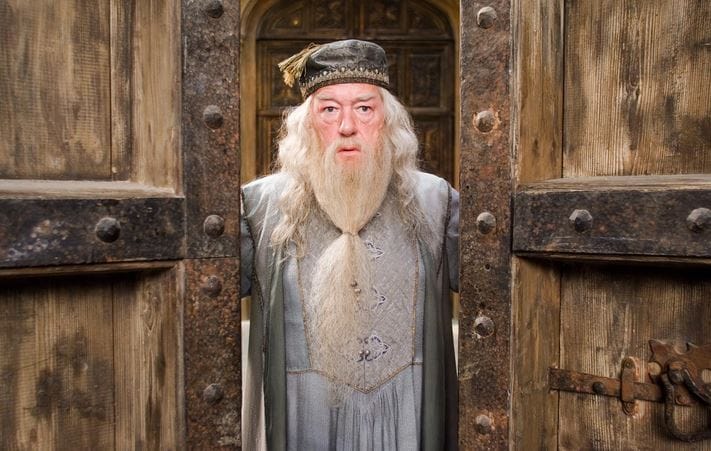
Dumbledore fits the “Death” role from The Tale of the Three Brothers because he is the one character who “handles” all three Hallows across the story, and he guides people (especially Harry) to accept death instead of running from it.
This is not confirmed as canon, but it is a famous fan theory because the parallels are too clean to ignore once you connect the clues from Deathly Hallows and the way Dumbledore behaves from Book 1 itself.
Recommended for You:- Was Arthur Weasley Under the Imperius Curse the Whole Time?
- Did The Dursleys Treat Harry Like Garbage Because He Was A Horcrux?
- The Sorting Hat reads potential, not personality
- The Hidden Meaning Behind Hermione’s Cat Crookshanks
Quick refresher: the Tale matters
In The Tale of the Three Brothers, Death meets three brothers after they escape a dangerous river, and he gives them three objects: the Elder Wand, the Resurrection Stone, and the Invisibility Cloak.
The first two brothers die because of their choices (power and obsession), but the third brother lives a full life, then “greets Death as an old friend” when the time is right.
That last line is the heart of this theory: the “right” relationship with death is not winning against it, but accepting it with peace.
Why people say “Dumbledore is Death”
The biggest reason: Dumbledore is connected to every single Hallow, and he “passes” them along like Death does in the story.
A popular version of the theory says Voldemort is like the first brother (Elder Wand obsession), Snape is like the second brother (living in the pain of lost love), and Harry is like the third brother (Cloak, humility, and acceptance).
In that pattern, Dumbledore naturally becomes “Death” — not as an evil monster, but as a guide who brings each person to their final truth.
Proof #1: Dumbledore “gives” Harry the Cloak
In Philosopher’s Stone, Dumbledore gives Harry the Invisibility Cloak as a Christmas gift, and the note says James left it with Dumbledore and now it is being returned.
This mirrors the fairy tale line where Death hands over his own Cloak to the third brother so he can go “without being followed” by Death.
It feels symbolic: Dumbledore is literally the one who puts the Cloak into Harry’s life, the same way “Death” does in the children’s tale.
Proof #2: Dumbledore also “gives” the Stone
In Deathly Hallows, Dumbledore leaves Harry the first Snitch he caught, and inside it is the Resurrection Stone (the Hallow linked to calling back the dead).
Even the way it opens is tied to death: the words on the Snitch are “I open at the close,” and Harry opens it when he walks to what he believes is his own death.
So again, Dumbledore is the one arranging that Harry receives a Hallow right when Harry is ready to face mortality, not when Harry is hungry for power.
Proof #3: Dumbledore had the Elder Wand too
Dumbledore is also shown to have possessed the Elder Wand, meaning at different times he was connected to all three Hallows, not just one.
That makes him unique: he is the only major character who has been the “keeper” of the full set in some form, which matches the idea of Death controlling these objects in the first place.
In simple words, the Hallows move through the wizarding world, but Dumbledore looks like the person quietly holding the strings.
The King’s Cross scene: Dumbledore as the “friendly Death”
The strongest emotional evidence comes from the King’s Cross chapter, where Harry meets Dumbledore in a white, in-between place after Voldemort’s curse hits him.
Dumbledore explains Harry has a choice: he can “go on” (board a train) or go back and finish the fight, which is exactly like a death-guide offering a final decision.
This lines up beautifully with the fairy tale ending: the third brother meets Death at the proper time and walks with him calmly, not in fear.
Also notice Dumbledore’s teaching style here: he doesn’t say “fight death at any cost,” he says the true master doesn’t run away from Death but accepts that dying is part of life.
What this theory really means (in simple Indian English)
This theory does not mean Dumbledore is a literal ghost with a scythe hiding inside Hogwarts.
It means Rowling may have written Dumbledore as a “Death-like” figure in a symbolic way: a person who understands death deeply, respects it, and helps others face it with courage.
That is why Dumbledore keeps telling Harry ideas like: accepting death is not weakness, and love matters more than fear.
Book-based connections you can mention
- Dumbledore is the one who returns the Cloak to Harry, like Death handing the Cloak to the third brother.
- Dumbledore arranges the Stone to reach Harry at the moment Harry is ready to die, not earlier.
- Dumbledore’s King’s Cross conversation feels like Death meeting Harry “as an old friend,” calm and honest, offering a choice.
One big counterpoint (so it stays believable)
In the actual books, Dumbledore himself says he suspects the Hallows were made by the Peverell brothers (powerful wizards), not literally by Death as a real being.
So, even if the theory is true on a symbolic level, the story still supports a “realistic” explanation inside the wizarding world too.