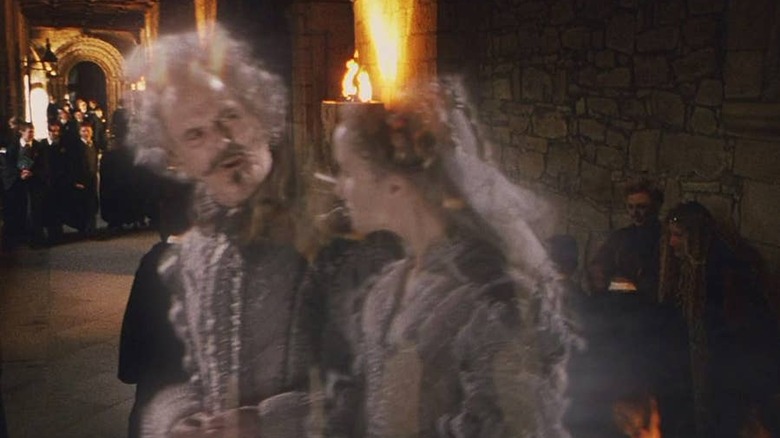
Hogwarts School of Witchcraft and Wizardry is full of moving staircases, hidden passages, talking portraits—and ghosts that have been drifting through its halls for centuries. Nearly Headless Nick floats through Gryffindor Tower like he owns the place.
The Bloody Baron terrifies Slytherins with his heavy chains. The Grey Lady glides silently in Ravenclaw’s corridors. Moaning Myrtle haunts a bathroom with dramatic dedication.
But here is the big mystery: if ghosts are spirits of the dead, why do Hogwarts ghosts never leave? Why don’t they travel the wizarding world, visit old homes, or move on to someplace calmer than a school full of noisy teenagers?
In this Harry Potter theory, we’ll explore the secret behind why Hogwarts ghosts stay. We’ll use clues from the books, Pottermore/Wizarding World lore, and what we know about magic, death, and powerful places. The short version is: Hogwarts is not just a building. It may act like a magical anchor for ghosts—by choice, by enchantment, and by unfinished business.
Let’s break it down.
Recommended for You:- Why the Quidditch World Cup Was a Hidden Warning
- Why the Patronus Charm Is More Mysterious Than You Think
- Why the Golden Snitch Was Designed to Hold Secrets
What Harry Potter Canon Says About Ghosts
Before we build a theory, we need the rules. In Harry Potter, ghosts are not the same as living souls. They are described as an “imprint” of a person who chose not to move on.
In Order of the Phoenix, Nearly Headless Nick explains it clearly. When Harry asks about Sirius, Nick says that Sirius will not come back as a ghost because “he went on.” Nick reveals that becoming a ghost is a choice made by witches and wizards who fear death, fear the unknown, or feel too attached to life.
That tells us something important: ghosts are created by refusal. A ghost is a person’s echo—staying behind because they could not let go.
So why Hogwarts? Why do these echoes gather there and remain there?
Theory Part 1: Hogwarts Is a Magical “Anchor Point” for Spirits
Hogwarts is one of the most heavily enchanted locations in the wizarding world. Even adult witches and wizards treat it like it’s alive.
Think about everything the castle can do:
- It shifts staircases and changes routes
- It contains rooms that appear only when needed (the Room of Requirement)
- It holds ancient protective enchantments
- It resists outside control, even by the Ministry
- It has boundaries that block Apparition (with rare exceptions)
Now imagine what a place like that does to a ghost.
A ghost is not fully “real” anymore. It is closer to magic than matter. So a castle overflowing with ancient spells may provide a kind of stability—like a lighthouse in fog. If the afterlife is unknown, Hogwarts might be the easiest place for a spirit to hold onto.
In simple terms, Hogwarts could be a magical anchor point that makes it easier for ghosts to exist.
This would explain why so many ghosts are found there, and why they don’t drift away. Leaving might be possible, but difficult—like walking away from the only thing keeping you steady.
Theory Part 2: Hogwarts Has Wards That “Bind” Spiritual Energy
Hogwarts was founded by four extremely powerful witches and wizards: Godric Gryffindor, Helga Hufflepuff, Rowena Ravenclaw, and Salazar Slytherin. Their magic still shapes the school a thousand years later.
We know founder-level magic can last centuries. The Sorting Hat still works. The House system remains magically meaningful. The castle still obeys deep rules that modern staff don’t fully control.
So here’s the theory: Hogwarts contains spiritual wards—old enchantments designed to keep certain energies inside.
Why would the founders create something like that?
Because Hogwarts is a school. A safe one, ideally. If a student dies (tragic, but possible in a world with magic creatures, cursed objects, and dangerous experiments), the founders might have wanted to prevent spiritual chaos.
A ghost roaming the countryside could become a threat, a secret, or a target for dark magic. But a ghost inside Hogwarts is supervised. It is contained. It is known.
These wards may not be “prison bars.” They might be more like invisible walls that make it hard for ghosts to pass through the school’s boundary. The ghosts can float through doors, but not through the castle’s outer protections.
This would also fit the idea that Hogwarts is protected in layers, not just from physical attackers but from magical forces of many kinds.
Theory Part 3: Hogwarts Feeds Ghosts Purpose—and Purpose Feeds Ghosts
Ghosts in Harry Potter feel emotion. They have personality. They talk, complain, and even hold grudges. That means they still rely on identity.
But identity needs a role.
Look at the Hogwarts ghosts. Most of them have jobs:
- Nearly Headless Nick is the Gryffindor House ghost
- The Fat Friar is the Hufflepuff House ghost
- The Grey Lady is the Ravenclaw House ghost
- The Bloody Baron is the Slytherin House ghost
- Professor Binns teaches History of Magic
- Moaning Myrtle haunts a bathroom and inserts herself into student drama
These are not random. Hogwarts gives them a “place” in the world.
If a ghost left, what would it be? A wandering memory with no one to talk to, no routine, no purpose. For a being that already struggles with the idea of moving on, that could feel like a second death.
So Hogwarts may keep ghosts because Hogwarts gives them meaning.
And in turn, their meaning keeps them stable enough to remain. In other words, the ghosts stay not only because they can, but because they need to.
Theory Part 4: Emotional Attachment Creates a “Haunting Lock”
In many stories, ghosts stay where they died or where they felt strong emotion. Harry Potter treats ghosts differently, but it still connects them to attachment.
Consider the strongest Hogwarts ghost stories:
- The Bloody Baron and the Grey Lady are bound by guilt, betrayal, and tragedy
- Myrtle is stuck in her teenage anger and sadness
- Nick remains sensitive about his death and his lack of “proper” beheading
- Binns never even noticed he died—his routine was stronger than reality
These examples show a pattern: the more emotionally stuck someone is, the more likely they are to remain.
Now add Hogwarts to that. Hogwarts is where many of these people lived their most intense moments—friendships, shame, ambition, heartbreak, fear, pride. For wizards and witches, school is not just school. It’s where they become themselves.
If their identity formed at Hogwarts, then Hogwarts becomes the easiest place for their ghost to attach.
Leaving might feel like tearing away the last thread holding them together.
So the “secret” may be emotional, not just magical: they can’t leave because the castle is tied to who they think they are.
Theory Part 5: Hogwarts Might Be Built on a Magical Ley Line (Or Something Similar
This is where the theory gets more speculative, but it’s fun—and it matches how fantasy often works.
Some places in the wizarding world seem naturally powerful. Think of:
- The Forbidden Forest (full of magical creatures)
- Certain ancient caves and hidden locations
- Places where big magic happened, leaving traces behind
Hogwarts sits on large grounds, near mountains and a lake, isolated from Muggles, and hidden by strong spells. It could be located on a naturally magical point—like a ley line intersection or a place where magic collects.
If Hogwarts is built on a magical “hotspot,” that would affect ghosts. A hotspot could supply energy that keeps spiritual imprints stable. It could also act like a magnet, drawing ghosts in and making it harder to drift away.
This theory also helps explain why Hogwarts is so unique compared to other schools. Durmstrang and Beauxbatons are impressive, but Hogwarts feels almost wild—alive, shifting, ancient.
Maybe the founders chose the site not just for privacy, but because the land itself was already enchanted.
What About Ghosts Outside Hogwarts?
Ghosts exist in other places, so Hogwarts isn’t the only location where spirits remain. We see ghosts at Nearly Headless Nick’s Deathday Party, and we know the Ministry has a whole Department of Mysteries studying death-related things.
But Hogwarts stands out because it has a whole community of ghosts. That suggests the castle is unusually comfortable for them.
And comfort matters. A ghost is a being that chose not to move forward. It makes sense that such a being would cling to the safest, most structured, most familiar place possible.
For many witches and wizards, that place is Hogwarts.
Why Peeves Changes the Picture (And Makes the Theory Stronger)
Peeves is not a ghost, but he behaves like one. He floats, causes chaos, and seems tied to the castle. He is a poltergeist—usually created by strong emotions, especially from groups of people.
Now think about Hogwarts: thousands of students over centuries, all feeling intense emotions—fear, excitement, jealousy, love, stress, pride. That is the perfect recipe for a poltergeist.
So if Hogwarts can “generate” Peeves from emotional energy, it might also “hold” ghosts through similar forces.
This supports a bigger idea: Hogwarts is an emotional and magical battery. It absorbs human experience and reshapes it into magical phenomena. That would make the castle a natural place for spirits and echoes to remain.
The Darker Theory: Hogwarts Doesn’t Let Ghosts Leave Because It Needs Them
Now let’s go one step darker.
What if Hogwarts benefits from its ghosts?
Not in an evil way, but in a practical magical way.
Ghosts provide:
- History and memory (Binns literally teaches it)
- House identity and tradition (the House ghosts reinforce culture)
- Social control (a haunting presence keeps students cautious)
- Magical “noise” that may confuse intruders
The ghosts are also like living security cameras. They drift through walls, report trouble, and spread news. In a castle where students frequently break rules, having spirits everywhere is useful.
So perhaps Hogwarts’s enchantments subtly encourage ghosts to remain. Not forcibly, but by making the castle feel like home to them—welcoming them, giving them roles, keeping them connected.
If Hogwarts is partly sentient (or at least self-regulating), it might treat ghosts as part of its ecosystem.
Like portraits, like house-elves, like the Sorting Hat—ghosts may be another layer of Hogwarts’s long-term survival.
Why Some Ghosts Seem “Stuck” in Specific Areas
Moaning Myrtle mostly stays in her bathroom. The Grey Lady is often seen in Ravenclaw areas. Nick stays near Gryffindor spaces. That suggests ghosts might be tied not only to the castle but to particular emotional centers inside it.
So the castle may not bind them evenly. Instead, each ghost could be attached to a “knot” of memory—where their strongest feelings live.
For Myrtle, that’s where she died and where her story froze. For the Grey Lady, it may be the places connected to her family, her secrets, and her regret. For Nick, it’s his social life and his desire to be respected.
This makes the haunting feel less like a random supernatural event and more like a magical psychology.
So Why Don’t Hogwarts Ghosts “Move On” After So Long?
This is the saddest part of the topic, but it matters.
Time doesn’t heal ghosts the way it heals living people. Ghosts in Harry Potter seem emotionally paused. They don’t grow much. They repeat stories and patterns. They still care about old insults, old betrayals, old tragedies.
That means they may not be able to “progress” toward moving on. The very thing that created them—the refusal to face death—keeps them stuck.
And Hogwarts, with its routine and tradition, may reinforce that stuckness. Every September, new students arrive. Every year, the same feasts, the same House competition, the same holiday decorations.
For a ghost, it’s perfect. Nothing requires change. Nothing forces them to face the unknown.
So they stay.
Not because they are trapped in chains, but because Hogwarts is a loop—and ghosts are beings who chose the loop over the door.
The Real Secret Behind Why Hogwarts Ghosts Never Leave
Put all the pieces together, and the answer becomes clear.
Hogwarts ghosts never leave because Hogwarts is the best place in the wizarding world for a ghost to exist.
It likely has:
- Powerful ancient wards that stabilize and contain spiritual energy
- A naturally magical location that acts like a magnet or anchor
- Endless emotional energy from generations of students
- Structure, tradition, and roles that give ghosts purpose
- Personal attachment for witches and wizards whose identities formed there
The ghosts may be able to leave sometimes, but doing so might weaken them, confuse them, or make them feel less “real.” And because ghosts already fear moving on, they choose the safest option: staying where they are remembered.
Hogwarts is not just a castle full of magic. It is a place that remembers you back.
And for a ghost, being remembered might be the closest thing to life.