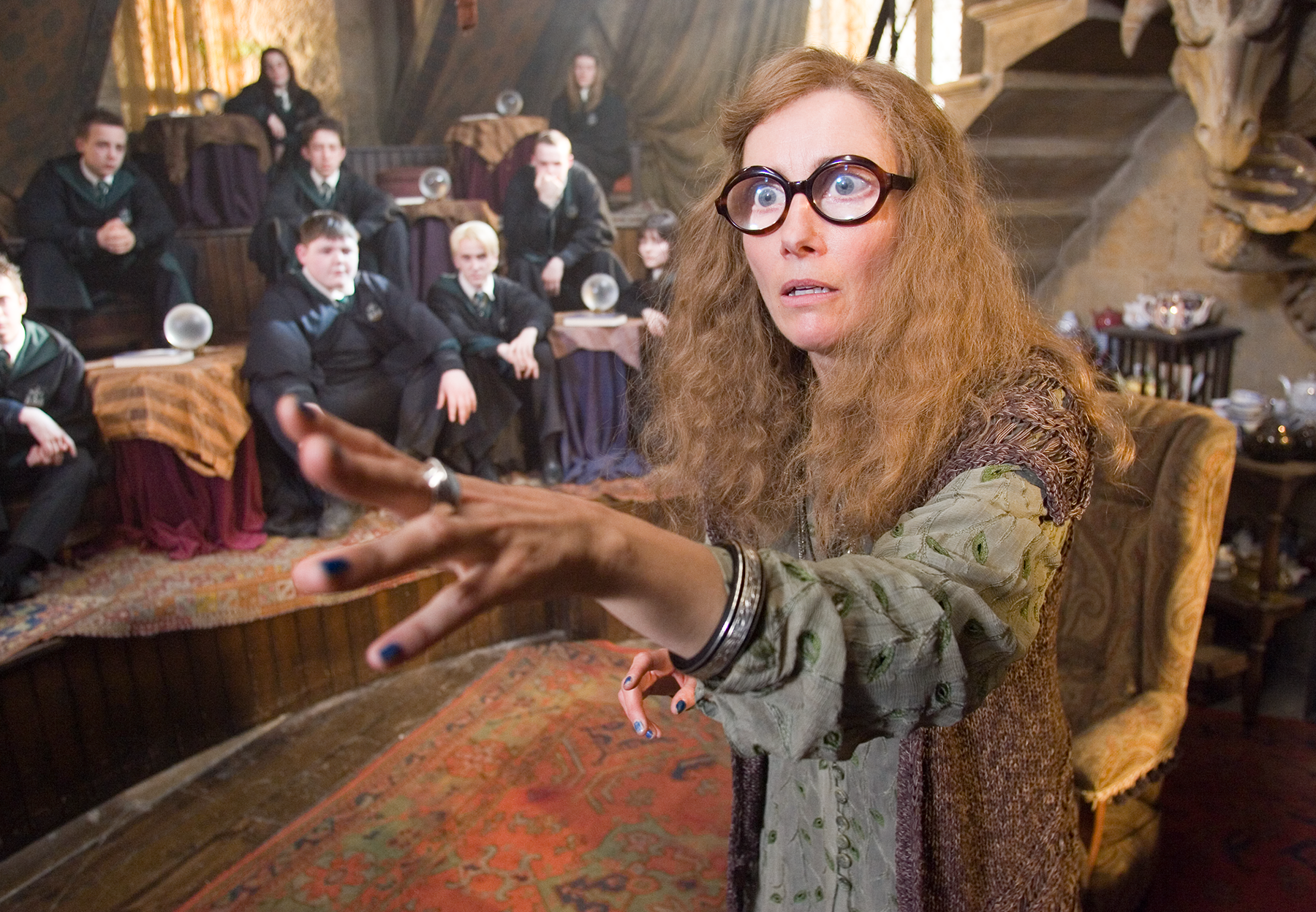
Professor Sybill Trelawney is one of the most misunderstood teachers at Hogwarts. Many fans (and characters) call her a fraud. Even Hermione quits Divination because she thinks the subject is nonsense. Professor McGonagall openly dislikes Divination too, and she strongly suggests it is not a serious branch of magic.
But here is the twist: Trelawney is not completely fake.
In fact, she makes two real prophecies that matter a lot. One of them is the famous prophecy about Harry and Voldemort. That alone proves she has genuine power. So why does she still look like a “fraud” most of the time?
This theory explores a simple but powerful idea: Trelawney’s “fake” predictions are not random. They work because she mixes real magical sensitivity, pattern-reading, and self-fulfilling fear. She also uses a classic survival technique: turning vague warnings into protection—sometimes without even knowing it.
Let’s break down the secret behind her reputation.
Recommended for You:- How the Time-Turner Could Have Prevented the Battle of Hogwarts
- The Real Reason Pettigrew Stayed Loyal to Voldemort
- Why the Patronus Charm Is More Mysterious Than You Think
- Why the Quidditch World Cup Was a Hidden Warning
The Big Truth: Trelawney Really Is a Seer
Before we call her fake, we need to remember one clear fact from the books: Trelawney delivers real prophecies.
Prophecy #1: The One That Starts Everything
In Harry Potter and the Prisoner of Azkaban, we learn that Trelawney made the prophecy that Dumbledore later told Harry:
- “The one with the power to vanquish the Dark Lord approaches…”
This prophecy leads Voldemort to target the Potters. It sets the entire story in motion. And Trelawney does not even remember making it, which matches how true prophecies often work in Harry Potter—like a trance.
Prophecy #2: The One About Voldemort’s Return
In the same book, she also makes another real prophecy in front of Harry:
- “The Dark Lord lies alone and friendless… his servant has been chained…”
That servant is Peter Pettigrew, who returns to Voldemort later. Again, Trelawney speaks with a different voice and seems unaware afterward.
So the secret is not whether she can predict the future. She can. The real question is:
Why does she look fake the rest of the time?
Theory: Trelawney Has Two Modes—True Sight and “Performance”
A strong way to understand Trelawney is to imagine she has two different modes:
- True Seer mode (rare, powerful, uncontrollable)
- Teacher/performer mode (common, theatrical, often wrong)
When she is truly prophesying, it happens suddenly, like magic taking control. When she is teaching, she is mostly guessing, acting, and using drama.
This makes sense for one big reason: real prophecy in the Harry Potter world is extremely rare. Even Dumbledore says that most “prophecies” do not come true. It is not like a normal spell you can do on demand.
So Trelawney, who is employed to teach Divination every week, has a problem. She must produce “Divination content” constantly, even though her real power appears only sometimes.
That pressure creates the perfect situation for fake-looking predictions.
Why Her Predictions Sound Fake (But Still Work)
Trelawney often uses very broad statements like:
- “A dark event is coming.”
- “One of you will leave us forever.”
- “Beware a red-haired man.”
Statements like these can feel cheap because they can fit many situations. But there is a clever reason why broad predictions can still become “true” in a magical world.
1) Hogwarts Is Naturally Full of Drama
If you predict danger at Hogwarts, you are almost always safe. Every year includes:
- A monster
- A Dark wizard plot
- A student in danger
- A teacher acting suspicious
- Some rule-breaking disaster
So when Trelawney predicts doom, she is basically guessing based on the school’s history. That is not magical prophecy, but it is not totally random either.
2) People Remember the Hits and Forget the Misses
This is a real human habit. If Trelawney makes 50 spooky predictions and 2 “match” later events, people will talk about the 2. The other 48 get forgotten.
Even readers do this. We remember when her words align with the plot, and we laugh at her failures.
3) Her Style Creates Self-Fulfilling Fear
When someone in authority predicts disaster, it changes behavior. Students get nervous. They make mistakes. They act differently. That can cause accidents that “prove” the prediction.
In simple words: if you keep telling someone they will fail, they might panic and fail.
Divination in Harry Potter is not only about seeing the future. Sometimes it shapes the future through belief and fear.
The “Fake” Predictions That Might Not Be Fake
Here is where the theory gets interesting. Some of Trelawney’s “wrong” or silly moments can be read as hidden accuracy. Not always, but often enough to make you wonder.
The Grim and Harry’s “Death”
Trelawney repeatedly sees the Grim around Harry, a sign of death in her tradition. Hermione thinks it is nonsense. But what does Harry keep running into?
- A large black dog (Sirius in Animagus form)
- Dangerous situations every year
- Near-death events constantly
So Trelawney may be “wrong” in the literal sense, but she is correct in the emotional sense: Harry is surrounded by death and danger.
Also, in many ways, Harry’s life is tied to death from the start—his parents’ deaths, Voldemort’s obsession, and his own sacrifice later.
“The First to Rise Will Be the First to Die”
This is one of the most famous “Trelawney moments.” At Christmas dinner (Prisoner of Azkaban), she refuses to sit because she believes that when 13 dine together, the first to rise will be the first to die.
People often say she is being silly. But fans noticed something chilling:
- There were already 13 at the table if you count Peter Pettigrew (as Scabbers) in Ron’s pocket.
- Dumbledore may have been the first to rise (depending on interpretation).
- Dumbledore does die first among those present.
Is it perfect proof? No. But it is enough to suggest her “silly superstition” sometimes connects to real magical truth.
Her Fear of the Number 13
The number 13 shows up again and again around major death moments in the series. It is easy to call it coincidence, but Rowling often uses repeated patterns on purpose.
So Trelawney’s obsession may be more than drama—it may be a Seer’s instinct expressed through superstition.
The Real Secret: She Uses Old Seer Traditions to Catch Real Patterns
Trelawney’s classroom is full of symbols:
- Tea leaves
- Crystal balls
- Star charts
- Palm reading
- Dream interpretation
Hermione hates these methods because they are not exact. But that might be the point. True prophecy is not clean and logical. It is symbolic.
Even in real life, symbolic systems are good at one thing: helping people notice patterns. And in the Harry Potter world, noticing patterns can actually matter because magic responds to meaning.
So here is the secret behind her “fake” predictions:
Trelawney’s tools are not reliable like a science experiment, but they are good at picking up emotional and magical signals. Her guesses are often based on real vibes—fear, tension, hidden danger, curses, and destiny.
She might not know she is doing it. But she may be sensing things around her and translating them into dramatic words.
Why Dumbledore Keeps Her at Hogwarts
This is a key clue. Dumbledore is not careless. He would not keep a completely useless fraud at Hogwarts for years, especially when he already dislikes “empty show” in many areas of life.
Yes, he keeps her safe because Voldemort might hunt her after her first prophecy. But that is not the whole story.
Dumbledore understands prophecy better than most. He knows:
- True Seers are rare
- Real prophecies can appear at any time
- Protecting a Seer can protect the future itself
So keeping Trelawney close is both a security move and a strategic move.
Also, her presence may act like a warning system. Even when she is “acting,” her instincts might point toward trouble.
The Acting Is Part of Her Shield
Trelawney behaves like a classic fortune-teller stereotype: big glasses, shaking voice, dramatic pauses, and constant doom.
This could be more than personality. It could be a defense.
If she acted calm and serious, people might investigate her, test her, or try to force prophecies out of her. That could be dangerous. It could attract Dark wizards who want to control the future.
But if she looks like a harmless fraud, most people ignore her. That keeps her safe.
So her “fake” behavior might be the perfect cover for a real Seer.
The Tragedy of Trelawney: She Cannot Control Her Gift
One of the saddest parts of Trelawney’s story is that she does not get credit for her real power. She cannot perform it on command. She cannot even remember it.
Imagine being talented at something very important, but only in rare moments, and then forgetting it afterward. Everyone thinks you are lying. You become insecure. You overcompensate.
That could explain why she becomes more theatrical over time. She is trying to prove herself in the only way she can.
And sadly, the more she tries, the less people respect her.
Hidden Accuracy: She Often Predicts “Themes,” Not Events
Another way to read Trelawney is to stop treating her predictions like exact news reports.
Instead, think of them like themes:
- Danger is coming
- Betrayal is near
- A secret is hidden
- Someone is not what they seem
- Death is close
Those themes match the Harry Potter books extremely well.
For example:
- In Goblet of Fire, betrayal and hidden identity are major themes (Moody/Crouch Jr.)
- In Chamber of Secrets, a hidden monster and secret history drive everything
- In Order of the Phoenix, denial and manipulation shape the year
Trelawney’s general doom fits because Hogwarts is a story shaped by destiny and conflict.
So even if she fails at specific details, she often catches the emotional shape of the future.
A Small But Powerful Clue: Her Lineage
We also know Trelawney is a descendant of Cassandra Trelawney, a famous Seer.
This matters because Rowling rarely includes family details for no reason. The Cassandra link tells us something important:
- Trelawney’s gift is real
- It is inherited
- It might appear in unpredictable bursts
This supports the idea that she has genuine ability but poor control.
The “Fake Predictions” Are Her Way of Teaching the Unteachable
Divination is hard to teach. It is closer to art than math.
So Trelawney may use drama as a teaching tool. She wants students to:
- Pay attention to symbols
- Trust intuition
- Respect the unknown
- Practice interpretation
Hermione wants rules and clear answers. But Divination is not built that way in the wizarding world. Even Firenze (a very different teacher) teaches it as something vast and uncertain.
Trelawney’s “fake” style might be her only way to make students feel the subject rather than calculate it.
What This Theory Changes About Trelawney
If this theory is right, then Trelawney is not simply a fraud. She is:
- A real Seer with rare, uncontrollable true prophecy
- A sensitive person who picks up real patterns more than she realizes
- A performer who exaggerates because she feels ignored and insecure
- A hidden asset to Dumbledore, even when she looks silly
Her “fake” predictions are the noise around a real signal. They make people dismiss her, but they also protect her. And sometimes, inside that noise, the truth slips out.
That is the secret behind Professor Trelawney’s “fake” predictions: they are not pure lies. They are a mixture of instinct, symbolism, fear, and rare moments of real prophecy—wrapped in a costume that makes the world laugh at her.