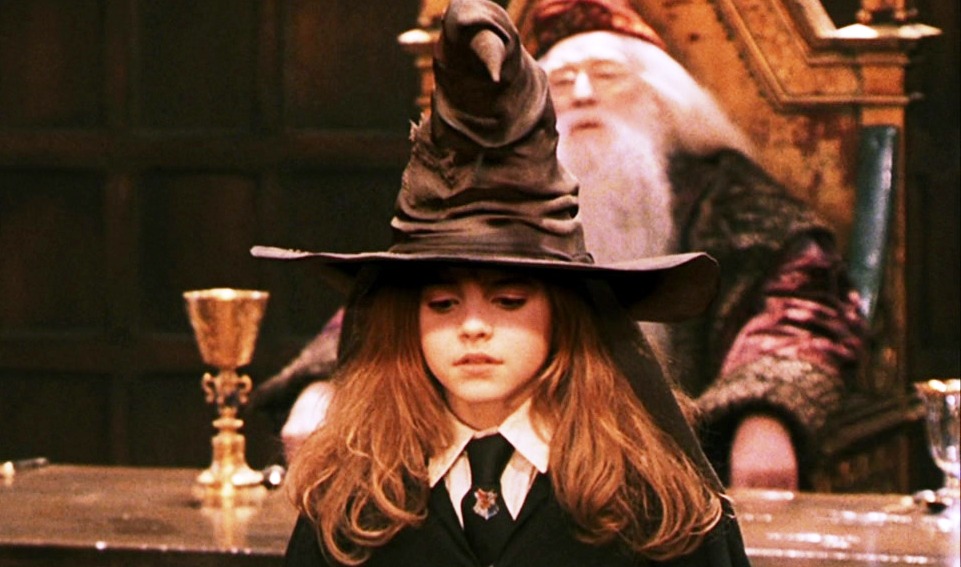
The Sorting Hat mainly reads a student’s potential (and what they value or could become), not just their fixed personality on day one at Hogwarts. This idea fits the books because the Hat looks inside the mind, notices hidden qualities, and even respects choice when it matters.
Recommended for You:- Dumbledore Was Actually “Death” All Along (Tale of the Three Brothers Explained)
- Was Arthur Weasley Under the Imperius Curse the Whole Time?
- The Hidden Meaning Behind Hermione’s Cat Crookshanks
- Why Ron’s Broken Wand Wasn’t an Accident
Why this theory makes sense
At eleven years old, most children are still forming their identity, so “personality” is not final. Dumbledore even says, “I sometimes think we Sort too soon …” which strongly hints that a child can grow into qualities that were not fully visible at first.
Also, the Sorting Hat does not behave like a simple quiz that labels you forever. It behaves like a magical evaluator that tries to place you where your best qualities can develop, even if you are not showing them confidently in that moment.
The Hat “reads your mind”
In the official Wizarding World writing, the Hat is described as using Legilimency (mind magic) to look into the wearer’s mind and judge their capabilities. This is important because Legilimency is not the same as observing behaviour; it can detect motives, fears, and inner conflict—things people may not show on their face.
So when we say “the Sorting Hat reads potential,” we are basically saying: it sees what is inside your head, including the qualities you might grow into. And since it can respond to what the wearer is thinking, it is clearly reacting to inner direction, not just outer personality.
Choice matters, so it can’t be only personality
One big book-based clue is that the Sorting Hat considers the student’s own preference in some cases. In Deathly Hallows, Harry tells Albus that if it matters to you, you can choose Gryffindor over Slytherin, because “The Sorting Hat takes your choice into account.”
If sorting was only about fixed personality, then choice should not matter at all. But the books suggest something more human: what you choose shows what you value, and values connect directly to who you want to become.
Harry: a clear “potential over personality” case
In Philosopher’s Stone, Harry is a nervous, confused boy who has just found out he is a wizard. His outward personality is not screaming “future leader” yet, but the Hat still senses multiple strong directions inside him (including Slytherin-like traits), and then it reacts when Harry strongly refuses Slytherin.
The official Wizarding World explanation also highlights this: the Hat changed its initial idea of putting Harry in Slytherin to Gryffindor because it could respond to what Harry was thinking and because it considers who you want to be. This supports the theory that the Hat reads a mix of inner capability and future direction, not a simple personality snapshot.
In simple words: Harry’s sorting shows the Hat is not only asking, “What are you like today?” It is also asking, “What path will make the best version of you?”
Neville: sorted for bravery he didn’t see yet
Neville Longbottom is one of the strongest examples that sorting is about potential. Early Neville looks scared, clumsy, and unsure, and many people would assume he is not Gryffindor material.
But the Wizarding World article explains that the Hat “saw a fire in him that Neville was yet to see himself,” and later Neville proves that bravery in many ways. It even connects Neville to major Gryffindor symbols, like pulling the sword of Gryffindor from the Sorting Hat, something described as possible only for a true Gryffindor.
That is exactly the point of this theory: the Hat sorted Neville for what he could grow into, not what he was confidently showing at age eleven.
Peter Pettigrew: the uncomfortable proof
Many fans feel Peter Pettigrew is the “sorting mistake,” because he later behaves like a coward and betrays his friends. The Wizarding World article also brings him up as a major example people question, and it discusses how sorting young is complicated.
But even this supports the “potential, not personality” idea. At eleven, Peter may have had the ability to be brave (or at least had the desire to belong with brave people), and if he had chosen differently later, his life could have gone another way. Dumbledore’s “Sort too soon” line fits perfectly here, because it suggests sorting is not a final judgment of who you will be forever.
So Pettigrew does not destroy the system; he highlights how potential can be wasted if a person makes wrong choices later.
Houses are not stereotypes
A common misunderstanding is to treat each House like a one-trait personality label:
- Gryffindor = brave
- Ravenclaw = intelligent
- Hufflepuff = loyal
- Slytherin = ambitious
But the books and official writing push a more realistic idea: people can have mixed traits, and they can change with time. The Wizarding World article explicitly says the Hat considers “the entire person,” and that it can place people in ways that do not match stereotypes.
That means a quiet student can still be brave, a kind student can still be ambitious, and a clever student can still value loyalty more than grades. The Hat is looking for the best “fit” for growth, not a perfect stereotype match.
What the Sorting Hat is really doing
If we combine these book-supported points, we get a strong theory:
- The Hat reads the mind, so it detects inner qualities and conflict, not just behaviour.
- The Hat can factor in choice, so values and future intention matter.
- Dumbledore admits sorting can be early, so the system assumes growth is coming.
- Neville’s case shows the Hat can identify qualities before the child expresses them confidently.
So, “The Sorting Hat reads potential, not personality” becomes very believable: it places you where your strengths can be built, and where your values can become your identity.
A simple way to see it
Think of it like how teachers in school sometimes notice a student’s talent before the student believes in it. A child may look shy today, but the teacher sees leadership potential if given the right environment. That is what Gryffindor did for Neville, and that is what choice did for Harry.
In the end, the Sorting Hat is not doing a “personality test.” It is doing a “future test”—with one important condition: your choices after sorting still decide what kind of witch or wizard you finally become.